


Aao, Aj Kuch Cook Shook Kariye! (Come, let's do some cooking shooking!)
- Chirag Maroke

- Aug 5, 2019
- 13 min read
Today marks the end of 4 weeks apprenticeship under the supervision of my mother. The subject of training was cooking. It has been a wonderfully satisfying experience - except, of course, of the lamentations of my supervisor that I am not making much progress. Be that as it may, I can still go ahead and contribute by writing about little understanding I gained and experiences I had.
Before dealing with various items of food I prepared (or assisted in preparing), it is crucial to take a step back and ask about importance of cooking. What purpose does cooking serve ? I have dealt with this topic once 4 years back when I (as a novice) wrote an essay on "Kitchen : an undervalued paradise". Till now I could possibly be tagged as a preacher rather than practitioner of those values; but now I can happily claim that I have found my paradise in kitchen too. This is the first purpose cooking serves for me.
Generally, cooking helps in multiple ways. It assist in channelizing your energy and creativity, gives you a new hobby, saves you money and health from eating food in restaurants, imparts independence & choice, and includes other such advantages. Beyond these individual centric benefits, cooking food also improves your social standing, helps build bonds, adds to your soft skills, and provide a significant way to touch others' hearts. Last point simply derived from a truism that way to a woman's(or man's) heart lies through the stomach.
Beyond this, there is a special value of cooking for men like me grown up in developing society that is intrinsically patriarchal and woman-biased. Irrespective of how much progressive one may assume himself, a man gets disproportionately less household responsibility than a woman. Thus, in a way, developing the skills and habit of cooking(well!) is an act of atonement for the male in general, and Indian male in particular. This, along with above multifarious reasons, serves a good basis for pursuing cooking as a regular activity.
When understood in this light, cooking would seem a noble and fruitful act. Yet, we escape from it, assigning it least priority in our affairs, even though food itself is primary source of life. I think the reason can be attributed to how cooking has been practiced. Traditionally, woman has been kept to bounds of kitchen not out of choice but circumstances that push them into it. For instance, even a well educated woman in the past had to give up their careers after marriage and for children. Such confinement do not induce love for cooking.
On the other hand, the modern self-confident woman, who is relatively unrestrained from the barriers posed to their mothers, may see kitchen work as undermining her equal status as man. At a time when she is enjoying her liberties with her friends and peers, mother's insistence for her to perform traditional functions can be irksome. Rightly or wrongly, it pushes her away from appreciating the joys of cooking even more. But the loss to society is self-evident : traditional in-house knowledge passed through generations is lost.
The fact that male-cooks are looked down upon and that woman are confined to kitchen acts as a catalyst for cooking being perceived as a daily grind than a creative activity. On the other hand, when we look at the intricacies involved in the process of cooking and beauty & taste of the ultimate product of cooking, it can not but be true that cooking is a creative art. It is this art that I was fascinated by in the past 4 weeks when I interned with my mother in her kitchen. Sharing of the knowledge I was imparted is a way of expressing my gratitude to intangible richness she, and woman like her, carries.
Parantha - Aalo ka, Gobi ka, Paneer ka, Muli ka, and, nowadays, Broccoli ka

Gobi & Paneer Parantha + Malai/Makhan.

The staple breakfast at a punjabi home is Paranthas. They come in variety - stuffed or non stuffed. I practiced with Gobi/Paneer and also made non-stuffed triangular shaped parantha. My mother also apply a paste of 'shakar' inside some non-stuffed parantha. It's like sweet roti but I saw that it is prone to getting burnt on tawa. Gobi/Broccoli will require extra cleaning in boiled water before using them.
The technique is simple if one knows how to make roti. Unlike roti, we make two "pede" of dough which will be smaller in size to an average roti. After increasing the diameter of each, we sandwich the grated vegetables. Before rolling it again, ensure that you seal the perimeter. Then roll it with 'belan' again after applying dry atta. As in Roti, when we roll the pressure applied to belan has to be soft so as to allow the dough to move on chakla.
Roti : Kneading + Rolling + Roasting(?)

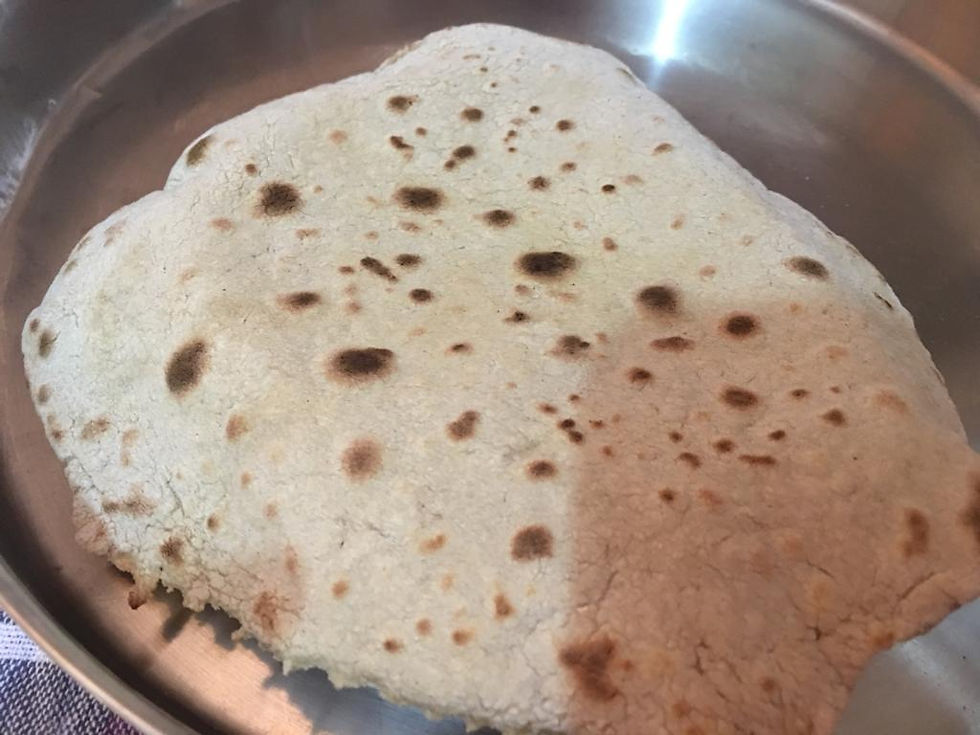
Unlike my mother's Roti, above has some rough lines on the periphery.
On the left is dough for three roti prepared in a Thali.
When I started making rotis, my customers were birds and ants. Roti would become an uneatable 'papad'. The problem was on various fronts : keeping the flames low, using less dry atta while rolling, late turning of roti on the tawa, et cetera. The problem was fixed after observing how mother prepared the same. Always let the tawa get heated well enough before putting your rolled dough on tawa. Make the first turn of roasting-roti on the tawa quickly. Finally, treat your roti with soft hands while pressing with a cloth. Let it get fluffy.
Preparation of dough wasn't as difficult as was being made out. For kneading, I found small patila to be more helpful than a thali. It keeps the contents in a compact area, allowing you to mix and press the dough properly, and also gives a better perception of amount of water needed. One important point made to me was to keep the batter after kneading for awhile before cooking roti. The roti comes out to be softer than the one shown in the photo above.
Breakfasts : Besan Chilla; Oats; Seeds; Eggs

Besan Chilla :
Just like we prepare omelette, we can have this healthy breakfast prepared in minutes. Prepare the batter with besan, water, chopped tomato/onion/ and whatever you want to add. Leave the batter for a while and then cook it just as you would an omelette. If you are using a non-stick tawa, you will not need much oil. Just a tea-spoon of drops and then with cloth spread it out. As we say in punjabi, bas 'sagan' paana hai("Only do the ritual" - not literal meaning though). This is a healthy alternative to eating market bread and escape for omelette on a busy morning. Eat it with dahi and you will love it. It's lightweight and healthy.

Seeds & Oats :
This is an everyday morning inputs into stomach for years now. At home, I eat one spoon powder of chia/sunflower/pumpkin seeds and almonds and pecan nuts every morning. It may not fill your stomach but it provides you with nutritious substances. I am taking box full of these with me.
Another way to eat them is to mix them up in your oatmeal. It imparts taste and substance to already nutritious oats. For preparing oats, boil the mixture of water and 3 spoonful of oats. Add some milk later. Leave the oats for a while before eating as it expand and become fluffy.
Pudi Cholley

Occasionally, you would want to skip your breakfast, and instead, you will like to just do a grand brunch. Pudi Cholley can be your go-to-meal, keeping in mind that it is only an occasional meal, not for everyday purpose.
The dough for pudi is prepared using normal atta + proportionate ghee + water. We can add tomato puree and methi too.
While making pudi, remember that we don't use dry atta while rolling batter. Instead, we apply a touch of oil to it. Oil that you use for frying pudi be sarson or canola. While using sarson ka tel, let it burn for a while before you start making pudi. The color and texture of the puree will be determined by factors like : ingredients of batter, oil used, rolling of batter, etc.
Choley - Rajma - Kale Channe
Pudi goes best with white cholley. The preparation of Choley is same as for any gravy-based dish - e.g. Rajma, Kale Channe, Matar Aalo Paneer, etc. Specifically for trio of Choley-Rajma-Channe, you should soak them in warm water overnight. Next morning, when you prepare the food, boil them with salted water till first whistle and let it simmer for 10 more minutes, and then leave the cooker aside till you prepare your tadka.

For readying Tadka, create a puree of onion, tomato, adrak, lasan, hari mirch. First use a cooker to pace up the process. After first whistle and additional 5-10 minutes, open the lid and fry it with desi ghee. Keep doing this till you get properly fried tadka. You would want to keep using your kadchi lest the tadka stick to base.
Now, you mix boiled channe/choley/rajma with your tadka. Add any additional water if required. Add Haldi and namak(if you didn't use salted water for boiling). Close and let it cook with closed lid for a while till one whistle. You can choose to add some masala -e.g. dry methi or dry jeera or dry anaardana. Finally, don't forget mashing peas/beans. It makes thick gravy.
White Rice

If you come from punjabi household, the consumption of rajma-chawal on regular basis is a given. Cooking rice is an easy task. For 3-4 members, you cook a glass of rice with two glass of water. Add a spoon or two of desi ghee. While it cooks in your pot, ensure you allow steam to escape, else water will overflow. Sometimes, you may soak the rice in water beforehand, then you can add less water in cooking.
Gud Vaale Chawal

At times, you want to give a twist to your rice. Either you make Jaggery rice or you can also try your hand at Jarda. I like the former so practiced that. Add jaggery to boiling water and dissolve it completely. Dip the rice in water for about half an hour. It helps in circumventing the problem of uncooked rice if sugared water is added straight into rice. Add desi ghee, methi seeds, dry coconut, dry fruits etc in the cooker. Just give it a small flame to get it started. Then add jaggery water along with rice into the cooker. Rest of the process is same as before. Keep it till first whistle goes, and then let it be for 10 minutes more. Remove from stove and keep the lid on and let it cook within the cooker.
Kheer

If you have leftover rice, it can be turned into dessert. Add milk and let it boil with rice. Add sugar according to your tongue requirements. You can choose to add 'shakar' if you have at home. It imparts a brownish tinge to the Kheer. Finally, either you can add dry fruit directly while cooking or you can add them later before eating. Both ways, you will enjoy one of important desserts of India.
Vegetables
Various types of vegetables can be cooked following a fundamental approach. We start by chopping onion/tomato/mirch. To the sauce pot, add desi ghee, jeera seeds, onion, adrak/lasan paste and fry them till it turns brownish. Add the vegetables and tomato after that, add some water(less for those that shrinks and leave water) and cover the lid for cooking. This process stays the same for almost all the vegetables. The differences appear in form of when to add vegetables, how much water to add, how much cooking time, etc.

Bhindi(Ladyfinger)
I call it my 'teenage-hood crush'. Prepare it in sarson oil. Cut and leave them overnight for drying. No water to be added while cooking. Add namak and haldi at the last when bhindi has cooked properly. It will leave water soon after. Cook for a while more and then it is ready to be eaten along with roti and dahi. I like to put the bhindi into dahi and devour full.

Kaali Tori
It is a shrinkable vegetable. So you don't add much water during cooking. A thing one can forget is that we have peel the vegetable before chopping. When you cook this, add everything together. Aalo, Onion, Tomato, Kali Tori etc. In the end you can add dry masalas to liven up the taste. Final product will be less than what raw ingredients may make us believe.

Gajar-Beans
It doesn't require any improvisation over the fundamental process. Keeping a balance between quantity of various vegetables is important. How finely you chop onions is another decision that requires attention. You can prepare it in desi ghee or sarson oil. While using the latter, remember to add hari mirch at later time, else your eyes and nose will suffer.

Baingan
Baingan comes in variety. I prepared using small white ones. Important technical point here is to slice and dip chopped baingan into water to prevent oxidation. Unlike bhindi and others, you can't keep them in open for long time. Cut them when you want to use. The same goes for mushrooms too. They turn black if left out after chopping. Rest is same process.
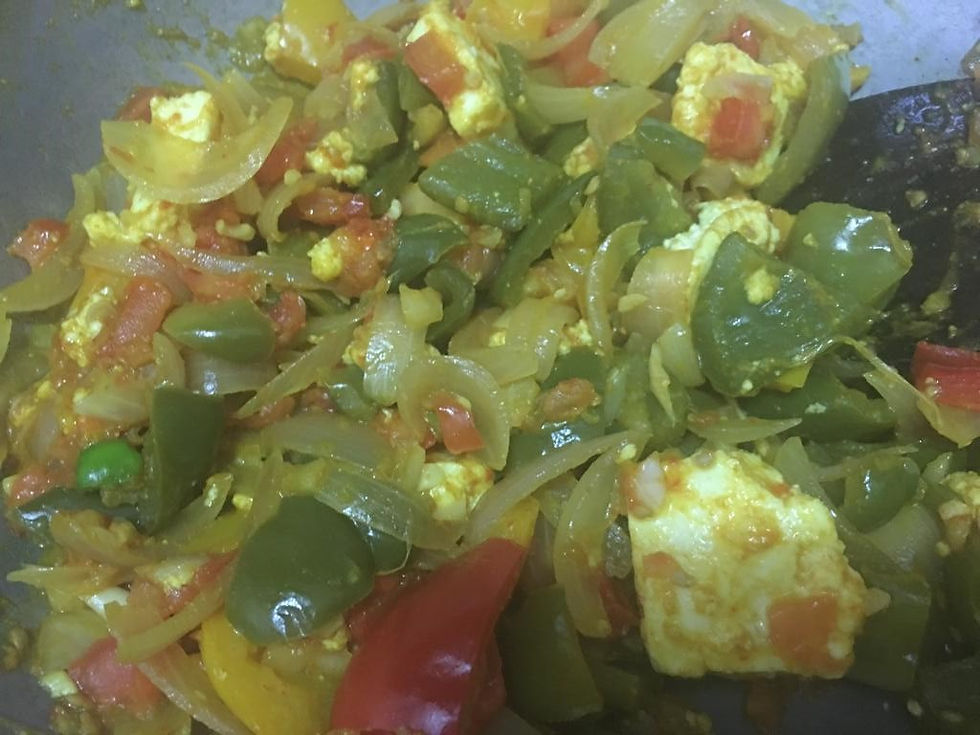
Shimla Paneer
Cooking time for vegetables is different. This governs the order in which they are added. Here shimla mirch goes alongside onion. A dairy product like paneer is added at the last. If you are using Aalo instead of Paneer, you have to add it alongside Shimla Mirch. Three may not go well together. So you have to recognize what combination yield tasty food.

Paneer Bhurji
This illustrates the fundamental process in its purity. Mix jeera, onion, tomato, mirch and fry them till they turn brownish. Add mashed paneer into it. Add haldi and salt to taste. People like me who are on lower side of BP can have more of salt. After this, you have to mix it up till it is ready. Paneer bhurji tastes great with non-stuffed parantha and dahi at mornings.

Gobi-Matar-Aalo
Three of them goes together into the pot. Gobi should be dipped into boiled water and its black part removed before cooking. A side fact about Matar is that they are winter crop, and cheaper during that period. You can buy them in winters during their availability and freeze for summer use. Add dry methi or jeera or pudina powder at last.
Besides these, there are some others that deserve honorary mention in absence of the picture. Kadu(round shaped) and Halwa are two important ones. For both, we use cooker. Mixing all the ingredients, adding some water and giving it one whistle. After which 10 more minutes and then open lid and then cook in open till it is done. Add water when needed.
Dal
About dal, I must confess that there hasn't been a serious practice. One dal I had prepared had 'sabat masar' mixed with some chana dal. We can create various combinations of dal and also use them alone. Wash the dal before use. Add water, dal, namak, haldi into a cooker. Allow it one whistle and then 10 minutes of simmering. Keep the cooked steamed after taking it off the stove. Prepare tadka separately, where you use finely chopped onion and tomato. Water if and when needed. Remember always that dal will expand and ghaadi hojaegi when kept after cooking. This process can be applied to every type of dal out there.
And then there are sins...

Seviyan
The process for cooking involves following steps : Add a cup of pre-roasted vermicelli into two spoon desi ghee and fry it. Add two cup water and let it cook. When it is close to getting dry, add a cup or so of sugar. Sugar will breakdown and leave water too. Adding water prior to sugar is for the vermicelli to be fully cook. Add dry fruits to the final product and devour it.

Noodles
Noodles are frowned upon in my family. We don't make it at home. Maybe once in 6 months or a year. That too because I buy them. I am not fond of them either. But one can cook them sometimes in emergency. Adding vegetables or paneer or egg will make it more nutritious.

Fruit Ice-cream
If you have fruit with you. Make a mix of them and add ice cream. Further, you can put grated chocolate, roohafsa, nuts etc. It will highly calorific but tasty. Overdose will lead to apathy towards it in future as I developed after repeated serving one day.

Shakes
This is not entirely a sin because it can be healthy if one keeps away from ice cream shakes. At home, you can easily prepare banana/mango shakes. Add other fruits into these shakes and it becomes even more healthy. Smoothies function in the same way.
Other way to make a shake is to add ice cream. I also mix ice cream to coke occasionally. The recent fad in my life of eating Faluda is also unsustainable. So is diverse types of chocolates and sweets. Sweet-tongued person as I am, I need an extra care to keep myself away from these sins lest I want to become a larger potato.

I am not cooking Kulfi Faluda at home. But given a chance I would like to taste whenever I get a chance to eat. It all started at Mohali. After that I have tried good number of Kulfi Faluda at Jalandhar. Now, after moving to US, I will hunt down places where Faluda is served. If pocket allowed, I will take the opportunity to taste them as well. The one in the picture is Kesar Kulfi Faluda.

Bhalla Chaat Papdi & Samosa: Not@home

Where is the Butter Chicken te Rotian???
It is a legitimate question to ask. I did learned to cook chicken but didn't get a chance to prepare it myself. I was taught by a cook at our government quarters. We don't cook chicken at our home. I was supposed to eat today but for some social commitments, I have to skip it and take rest today. Instead, I went to Jalandhar and ate various items that delights the taste buds.
Preparation of chicken has some commonalities with other veg curries. We prepare tadka in the same way as we did for them. Here, we also add some chicken masalas and garam masalas. Mixing the raw chicken with curd before cooking helps in keeping the chicken from falling out from bones while cooking. Cook till whistle and then leave it for about 10 minutes or so and later let it cook with steam.
What's next ?
My experienced friends in US say that it is not possible to cook every other day and that too different vegetables/dal etc. I haven't yet understood the reason. Some say it is the time constraint. Others say that it is about Niyat. Maybe it is just the time availability now that allowed me to practice cooking. It is quite possible that I may end up being one of those who don't cook regularly. But one thing I may certain about is that I will not participate in the bizarre plans that were doing rounds in UF groups about eating some community meals and all. It is not because I disagree with their quality. It is only that if I can spend time and effort to got outside and eat those meals, I can also make that effort to cook myself a quality food at home too. Instead of going out or wasting time where one can avoid, I should try to cook my food everyday. Eating quality food is central for good mental health and I should try to maintain one as I am getting back into the rigorous life of a student once again. In any case, it will be good escape from the tension or stress that may creep in during this new Masters adventure. In situations like this, I can tell myself(and flatmates) - Aao, Aj Kuch Cook Shook Kariye!

Comments